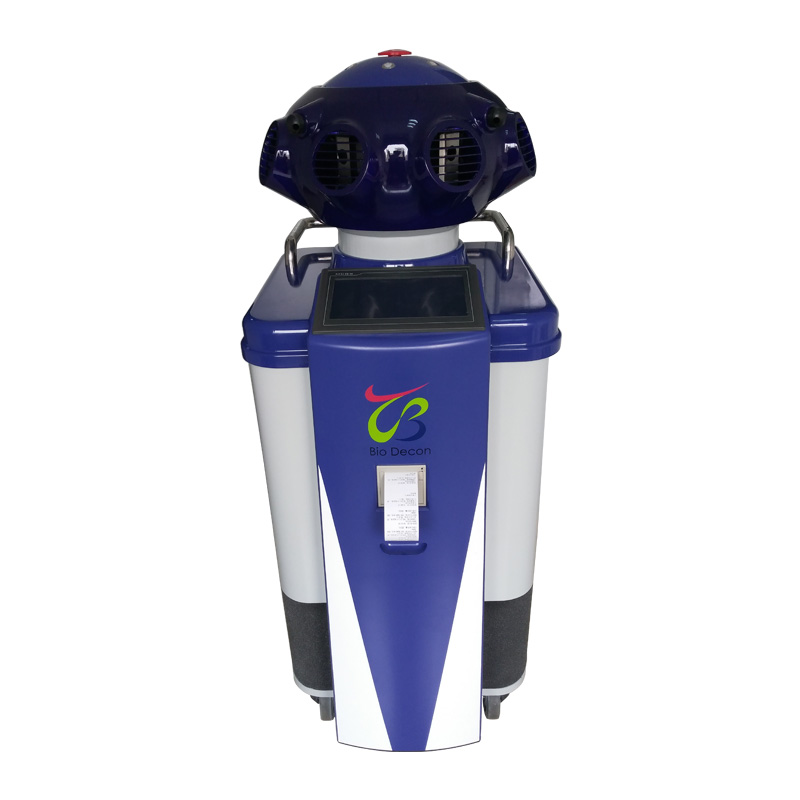
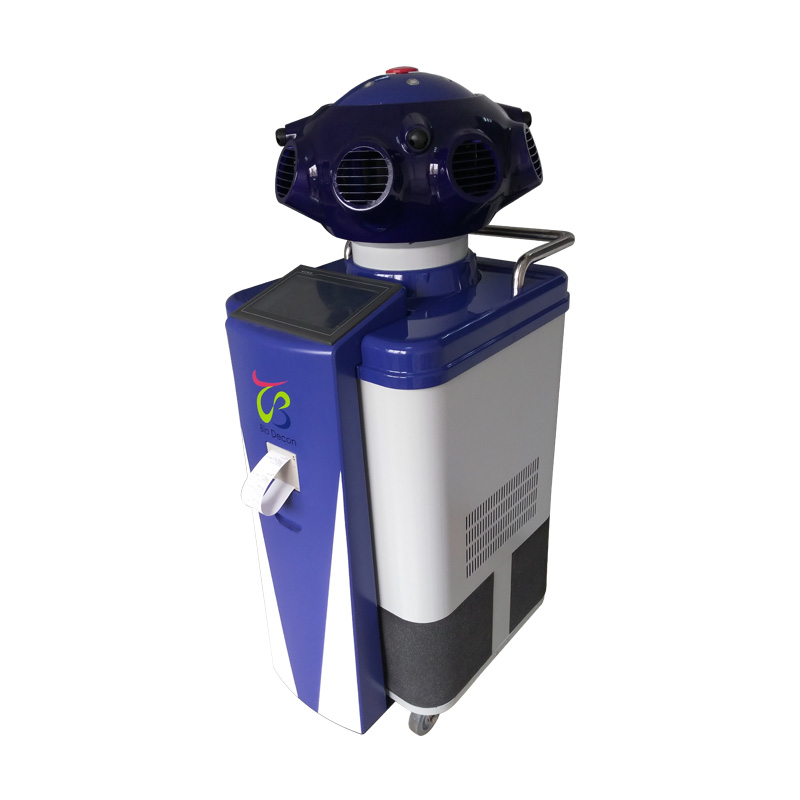
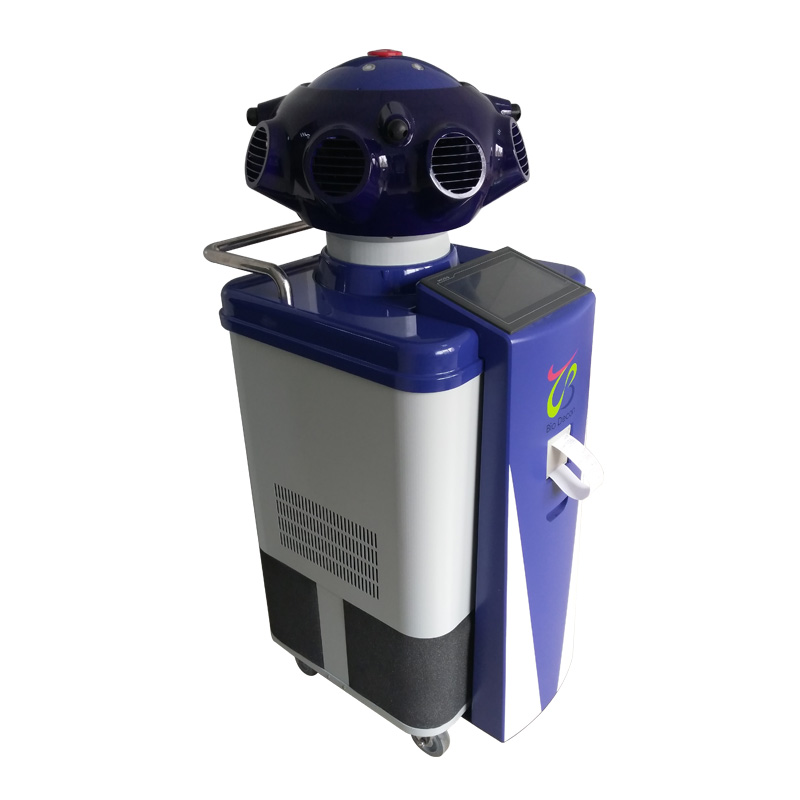
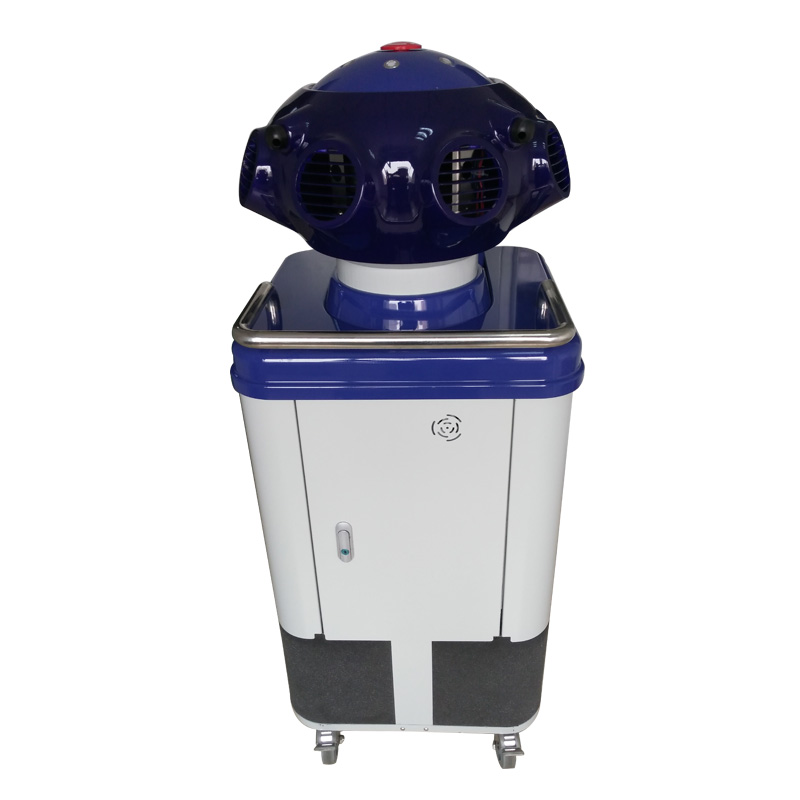
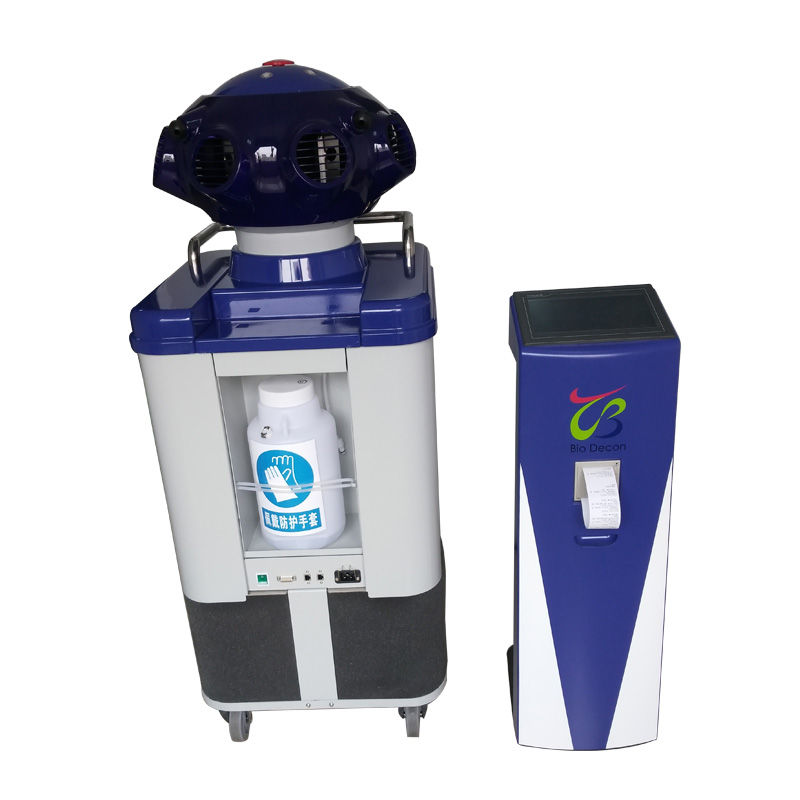
| Equipment model | |
|---|---|
| Structural materials | Aluminum, ABS, Stainless Steel, Ethylene Polymer (PVC) |
| Temperature (operation storage) |
15 ° C to 35 ° C 0 ° C to 35 ° C |
| Relative humidity (operation storage) |
25-75% RH 95% RH (maximum, no condensation) |
| power supply | AC 220V 50/60 Hz 15A |
| power | 3000W |
| work location | upright erect endlong |
| Size (wxdxh) | 566 x 730 x 1420 mm |
| weight | 110 kg |
| Maximum hydrogen peroxide solution loading | 5.0 liters |
| air flow volume |
Steam - 60 cubic meters per hour Diffusion wind - 950 cubic meters / hour |
| Steam temperature | 55-70°C |
| Hydrogen peroxide liquid injection rate | 0 - 30 g / min |
| noise | 80 DBA (degradation phase) |
| hydrogen peroxide peroxide | 30-35% W / W analysis pure level |
: H2O2 body control switch: fan speed monitor
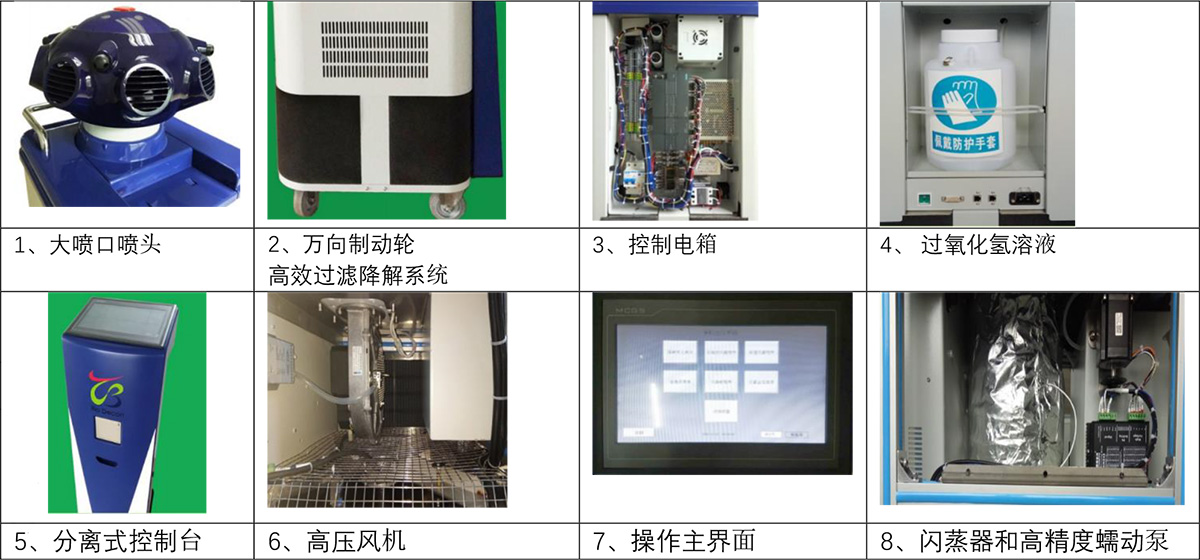
(1) 3M long power cord (IEC C19 / 20)
(2) 7.5M long winch control line
(3) Handheld low concentration hydrogen peroxide gas concentration detector
(4) Goggles
(5) disposable gloves
(6) 2 volume printing paper
(7) Operating manual can be equipped with a long control cable
(1) Based on the "wet" sterilization theory, it is better to sterilize the sterilization of "dry method\\
(2) Domestic equipment, performance can be used in parallel equipment, and the price is honest, spare parts and service response.
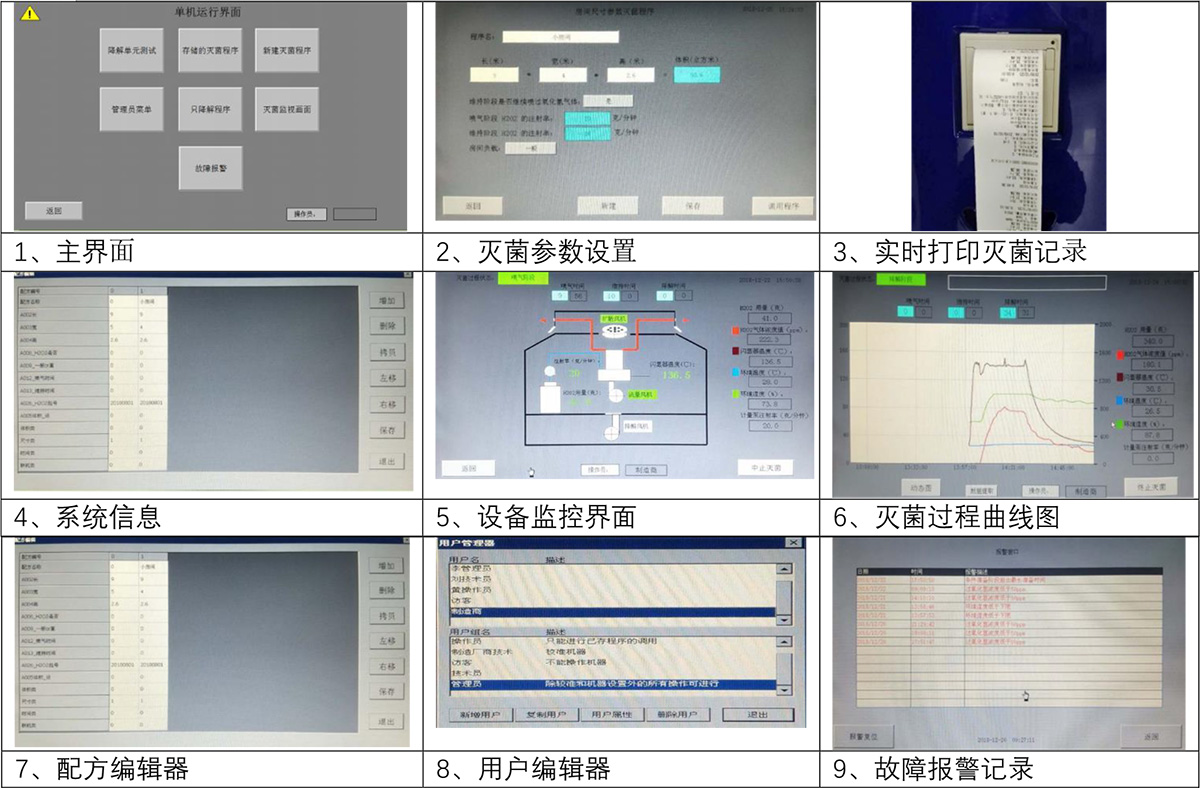
(3) Chinese user interface, easy to play hands, real-time graphical display sterilization process
(4) Fully automatic completion of the sterilization process, no need to monitor and participate, you can start the sterilization in the evening, you can restore the production activities of the sterilization area during the morning.
(5) Multi-machine network sterilization can meet the sterilization needs of large area regions
(6) The metering pump is accurate and reliable, the sterilization effect is stable and repeatable, reproducible process
(7) Algorithm is reliable, do not require special sterilization procedures development
(8) You can print a complete sterilization process record, data can be saved
(1) Domestic analytical pure (Ar) level, 30% (w / w) hydrogen peroxide solution can reach 6-log sterilization effect
(2) The hydrogen peroxide solution of 5 liters of capacity can theoretically sterilize the maximum 500 cubic meters of room.
(3) Convenient, easy to use, no complex installation
(4) Simple program setting, simply enter the room size to generate a suitable sterilization program; the sterilization process is fully automated, and there is no need to participate and monitor
(5) Single spatial area simply uses BDS-5000 self-diffusion systems for sterilization and built-in degradation systems for decomposition of remaining hydrogen peroxide gases.
(6) Sterilization cycle time is short, greatly improves the efficiency of the use of the area to be sterilized
(7) The annual maintenance requirements are low, and the maintenance cost is also low.
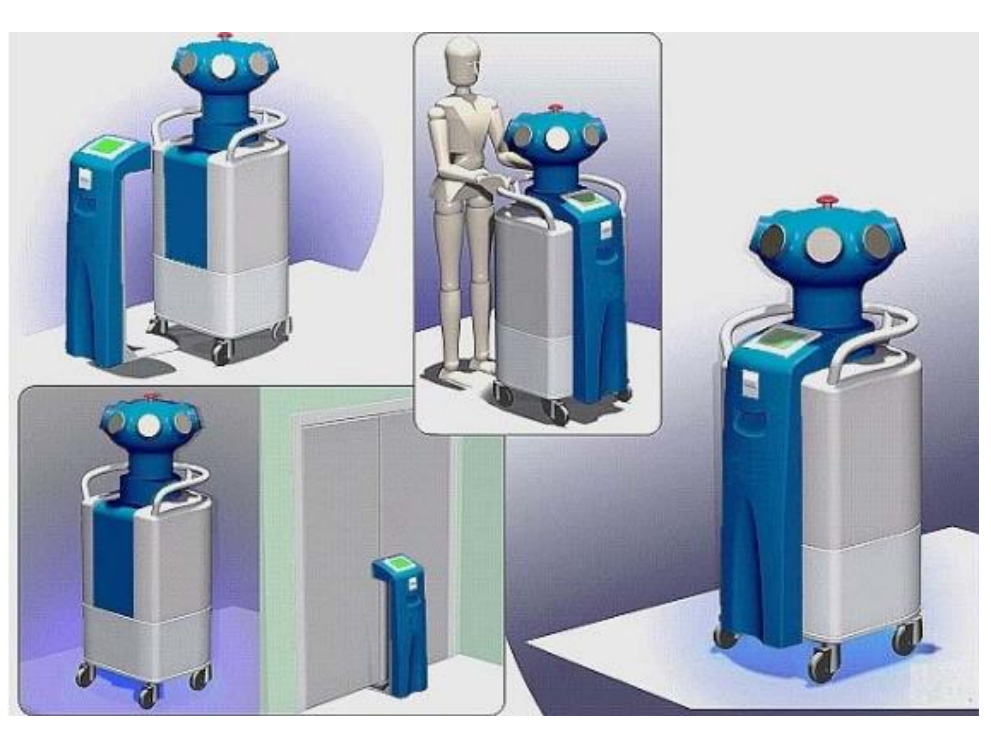
The BDS-5000 operation is simple and convenient. After preliminary estimation of the size and environmental conditions to be sterilized, the BDS-5000 is initially estimated, and the sterilizer is pushed into the room, connect the main power supply, put the control panel outside the door, close the door and will All gaps can be started with the colloidal tape to start the sterilization process. (The use of BDS-5000)
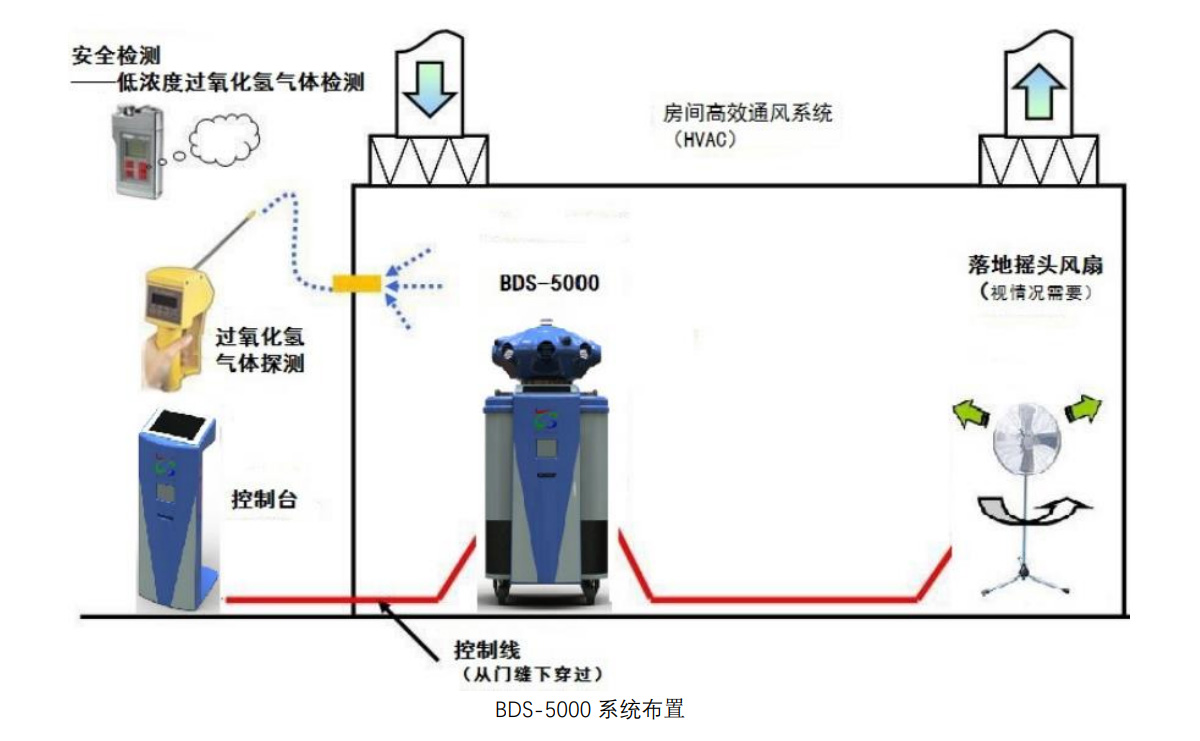
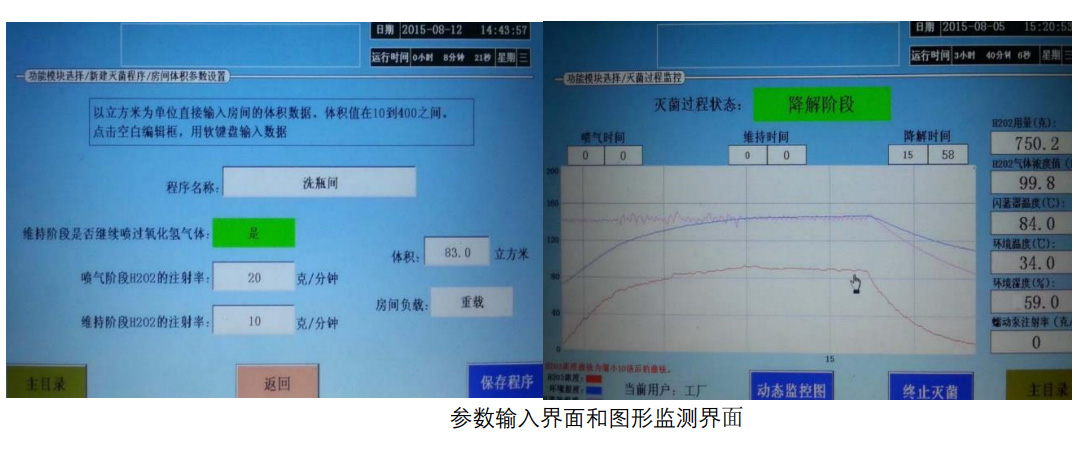
Parameters such as long, width, high or volume are input to the console software interface, and the sterilization process can be initiated outside the room. The generator will automatically calculate the amount of hydrogen peroxide required to achieve saturation conditions based on the room size and environmental conditions, determine the runtime of each stage of the sterilization process, thereby defining the sterilization procedure.
After starting the generator, the hydrogen peroxide liquid will be vaporized and spread through the built-in diffusion system to the entire room. The machine's own intra-hydrogen peroxide gas concentration monitor monitors the concentration, temperature and humidity of the fluid hydrogen gas, maintains the vaporization process until the ideal sterilization conditions are reached, and the state is maintained until it is to ensure sterilization. After reaching the sterilization purpose, the machine starts degradation channel, the catalyst efficiency and the ventilation unit will automatically open the residual hydrogen peroxide gas in the room into water vapor and oxygen. The hydrogen peroxide gas concentration monitor will continue to monitor until re-entering the safety conditions.
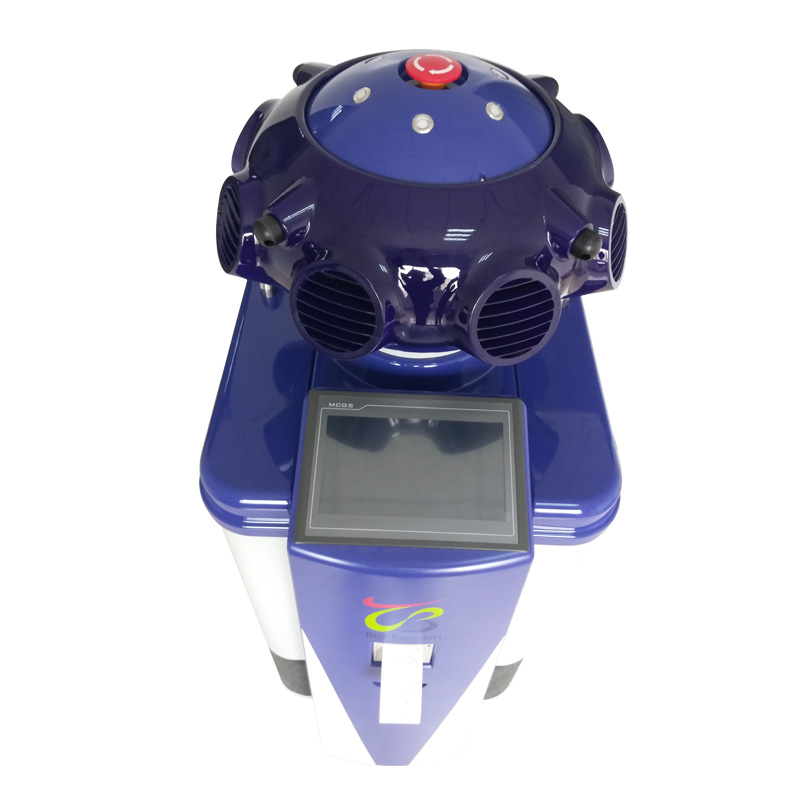
During the sterilization operation, the process measurement parameters are displayed on the touch screen in a chart. If you need this information, you can download it to your computer. The console also includes a thermal printer that prints the parameters of each cycle phase. All alarm process will also be printed. When the loop is coming, the operator can measure the concentration of the indoor residual hydrogen peroxide to ensure safe entering the room.
(1) Remove the console, push the generator host into the room, connect the power supply
(2) Place the console in the room, connect the console and generator with the cable.
(3) Place the bottle of hydrogen peroxide solution in the generator bottle
(4) Seal the door of the room with the tape
(5) Close the room ventilation
(6) Enter a room size or volume size on the console touch screen, select the room load status
(7) Start the sterilization process
(8) Check whether there is hydrogen peroxide leak on the door on the door using a handheld hydrogen peroxide gas detector
(9) Sterilization, if the room HVAC system is straight, restart the room ventilation after the start of the ventilation degradation phase, accelerate the decomposition of the remaining hydrogen peroxide gas in the room, speed up the recovery of the room usage process
(10) Sterilization cycle end stage (according to the prompts of the generator), open the door, measure the hydrogen peroxide vapor concentration with hand-held low-concentration hydrogen peroxide gas detector
(11) If the hydrogen peroxide gas concentration in the room is less than 1 ppm after the end of the sterilization cycle, the equipment is collected according to standard operation procedures (SOP), and the room is returned to the production.
(1) Preparation stage - to preheat the flashboard, pipes, and nozzles to achieve a suitable operating temperature. It takes only 7 minutes this stage.
(2) The vaporization stage ---- The hydrogen peroxide solution drops to the flash plate, quickly vapor into steam, spray into the sterilization space. Flash effect: The hydrogen peroxide steam diffuses through the nozzle to the respective corners of the separator until the saturation is reached. Saturated state we call it "condensation point" - that is, the air cannot accommodate more hydrogen peroxide vapor in air, and hydrogen peroxide steam becomes a microaceous state. This state is the best killing effect on the microorganism. This phase of time is different from the size of the short-range space, which can be set by machine intelligence, or program development (GCD) is defined.
(3) Maintenance phase - At this stage, there will be constantly hydrogen peroxide steam to be injected into the space, maintain the saturation of the steam to achieve continuous coverage of the sterilization surface and the continuous killing of the microorganism. This phase of time is different from the size of the short-range space, which can be set by machine intelligence, or program development (GCD) is defined.
The hydrogen peroxide concentration is less than 1 ppm. This phase is time consuming.
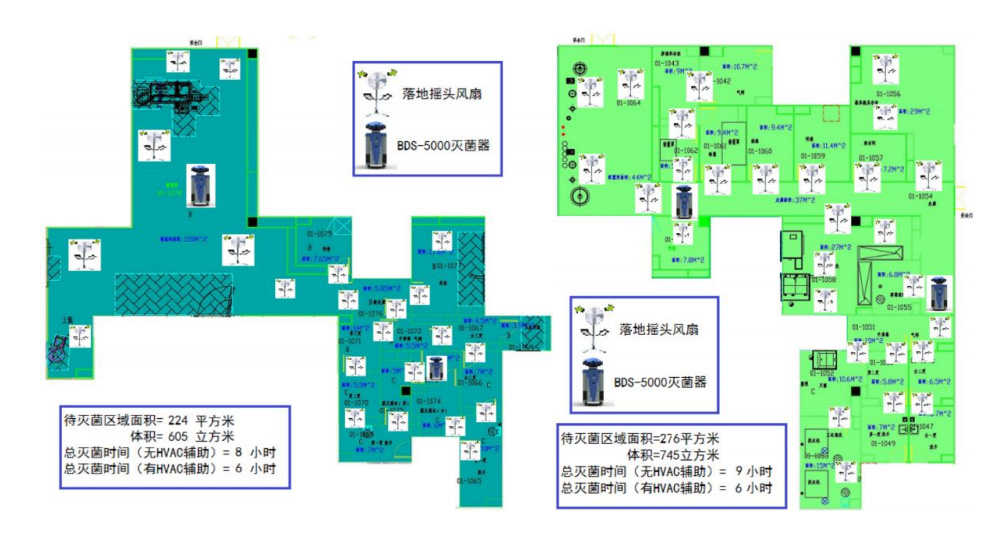
The mobile catalytic ventilation unit is specifically designed to meet the need for fast ventilation degradation, especially suitable for auxiliary ventilation degradation of larger spaces and regions without a room ventilation system. The device is placed in a sterilization zone and is automatically activated by the generator after completion of the vaporization phase. After sterilization, the concentration of hydrogen peroxide in the indoor air is high, and the air is recovered by a ventilated degradation system to degrade the hydrogen peroxide gas as water vapor and oxygen, and then efficiently filtered into the room. The gas discharged from the special ventilation degradation unit is very fast, which will produce a dramatic airflow, which avoids the gas flow angle in the room.
The landing shaking fan is mainly used for the spread of hydrogen peroxide steam, and the user can prepare itself when sterilization.
Measuring the hydrogen peroxide gas concentration from the place where the generator is moved in the sterilization region
When the area is large, the length of the control cable accessories can be selected from the main unit to the control cable from the host to the console, and the extended control cable accessories can be optionally connected to the Console.
2 sterilization plan
To achieve the relative humidity of the set, it is generally 40% and below; our BDS-5000 is "wet" sterilization theory, that is, the sterilized room or hatter is not required in the early stage of the sterilization. operate. This process, there is a point you need to pay attention:
This is extremely unfavorable;
2, energy consumption: ------ dehumidification operation will consume more electrical energy
3, the cost is higher: ------ Removal function requires additional equipment, adding the cost of the purchase, and the cost of future maintenance;
4, system complexity: ------ Our technology does not need to dehumidify, normal environmental conditions, and under the premise of ensuring more excellent killing, dehumidification apparently makes the sterilization process complicated, use Not convenient enough; BDS-5000 has a relatively loose requirement of humidity, greatly adapting to various environmental conditions, ensuring efficient use in all kinds of places and equipment.
By specially designed "flash" technique, the BDS-5000 will generate 30-35% analysis of the pure grade hydrogen peroxide solution into a gaseous molecular state, which particle diameter is a pampi (2.97x10e-12), which is pure The gaseous, the diffusibility is excellent; other equipment cannot be completely gaseous in this regard, containing a large amount of impurities, so the filter must be passed during discharge; when the resulting is not a pure gas, it (dry mist or When the wet fog is, the two have the difference in nature. Of course, because there is a large defect in the atomization system, it is not accepted for most units.
1, hydrogen peroxide liquid concentration:
Some other brand devices use a hydrogen peroxide solution with a concentration of about 60%, which is extremely dangerous, greatly increasing the difficulty of control, and there is a great explosion risk at the time of operation; and due to high concentration The hydrogen peroxide solution produces condensation, when cooling, the liquid droplets will drop on the machine panel, causing corrosion of the equipment itself; in addition, the high concentration of hydrogen peroxide stock solution is also difficult, safe in transport The requirements will also be higher, which greatly limits the use of customers;
2, sterilizer concentration:
Other brands of equipment, its sterilization process is very weak to concentration, because mostly use dry sterilization, in the case where humidity is low enough, the concentration of hydrogen peroxide in the environment will be quickly out of control, which is large Leakage risk, and corrosion of materials;
3, sterilization efficiency:
In sterilization, due to the low humidity, hydrogen peroxide can only be irregular random motion, the efficiency is extremely low; the BDS-5000 is revealed, and there is a certain humidity (water molecule) in the surface of the particles, its HPV molecule can be "targeted "The surface is covered on the surface of the particles, forming a" micro-condensed "formation of a layer of naked eye to quickly and efficiently sterilizing, and its efficiency is significantly improved.
4, single cycle - double cycle
Other brands of equipment use single-cycle models, and the intentions are as follows:
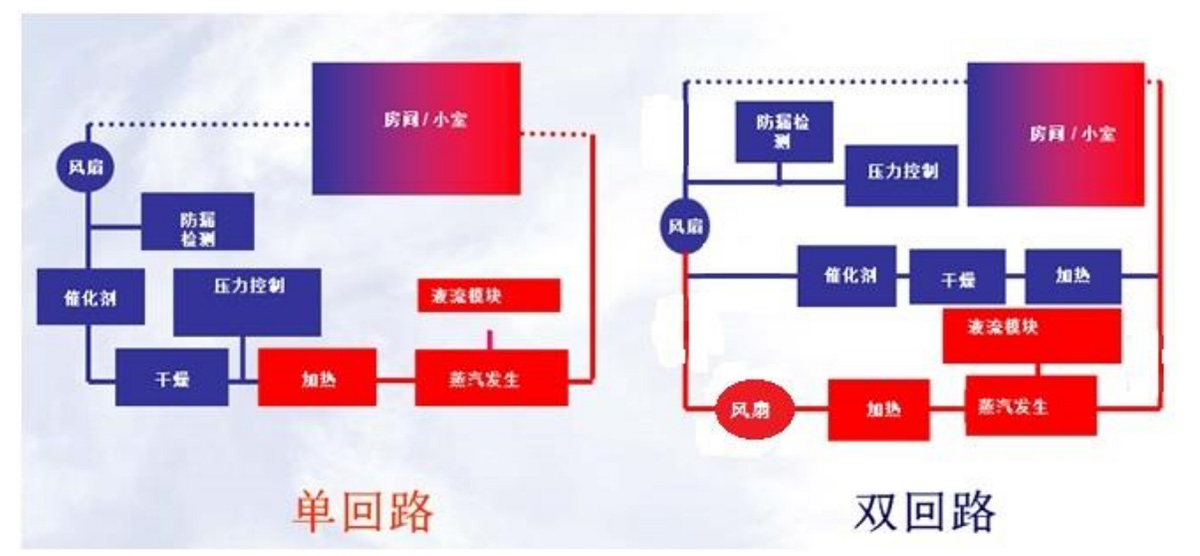
As shown in the figure, since the loop of the single loop will continue to decompose hydrogen peroxide, this exists two problems:
1) Consume more hydrogen peroxide and increase the cost of consumables;
2) When it is prolonging sterilization

Scan it